Jump to Content
USB Charger Market - Global Size, Share, Trends and Industry Forecast (2026-2033)
USB Charger Market Size :
The global USB charger market stood at approximately USD 30.2 Billion in 2024 and is estimated to reach USD 32.22 Billion in 2025. Riding on steady demand for USB-C fast-charging hardware and tightening government charging-port regulations, the market is projected to touch USD 54.13 Billion by 2033, expanding at a CAGR of 6.7% between 2026 and 2033. Some industry estimates that extend the outlook to a longer horizon put the market as high as USD 63.93 Billion by 2035, underscoring the durability of demand for USB-based charging hardware well into the next decade.
USB Charger Market Scope & Overview:
A USB charger is a compact, portable power-conversion device that supplies current to electronic devices through a USB (Universal Serial Bus) connection. Chargers of this kind are used every day to power smartphones, tablets, laptops, digital cameras, portable speakers, wearables, and a fast-growing list of IoT accessories. They come in several formats — wall chargers, car chargers, and portable power banks — so buyers can pick the format that fits their lifestyle, whether that's a desk, a vehicle, or a backpack.
Modern USB chargers are built around intelligent circuitry that guards against overcharging, overheating, and short circuits, and most now ship with multiple ports so several devices can be topped up at once. Fast-charging protocols such as Quick Charge and USB Power Delivery (PD) have become standard rather than premium features, and many chargers now carry smart chips that automatically size the power output to the connected device, improving both charging speed and battery longevity. The shift toward GaN (Gallium Nitride) semiconductor charger designs is also compressing the size of high-wattage adapters, letting a single 100W-140W brick replace what used to be three or four separate chargers.
USB Charger Market Insights :

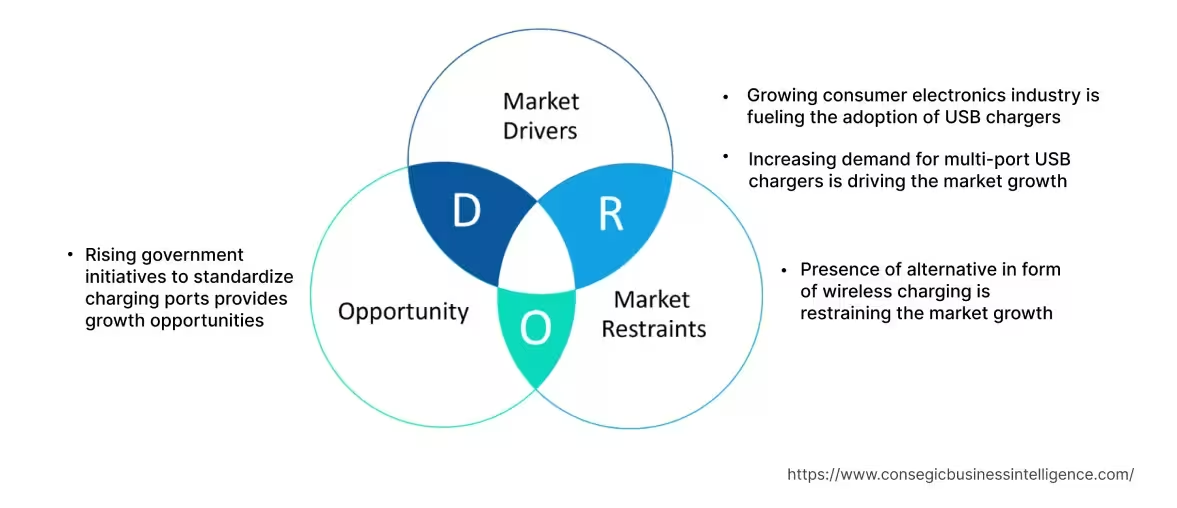
USB Charger Market Dynamics - (DRO) :
Key Drivers :
Rising device ownership and daily reliance on connected electronics
USB chargers remain the simplest way to keep an ever-expanding fleet of personal devices running, letting a household or a business replace multiple proprietary chargers with a single compatible cable and adapter. Their portability and near-universal compatibility make them the default charging accessory for smartphones, tablets, laptops, and wearables alike. The strongest pull on demand continues to come from fast-charging capability: consumers increasingly choose a charger based on how quickly it can top up a device, not merely whether it fits the port. As device makers pack more power-hungry features into everyday electronics, the underlying electronics industry keeps expanding, and that expansion continues to translate directly into charger demand.
Growing appetite for multi-port and high-wattage chargers
Multi-port chargers that can power several devices from one outlet are becoming the norm rather than the exception, particularly for travelers and hybrid workers who carry a phone, tablet, and laptop together. Intelligent power-distribution circuitry now lets a single charger split its total wattage safely and efficiently across every connected port. Compact GaN-based designs have made even 100W-plus multi-port bricks small enough to slip into a bag, which is accelerating replacement of older, bulkier single-port adapters across both consumer and professional segments.
Key Restraints:
Wireless charging continues to chip away at wired-charger demand
Wireless charging remains the clearest substitute threat to the USB charger market. It removes the need for cables and connectors altogether, cuts down on port wear from repeated plugging and unplugging, and gives users more flexibility in where and how they place a device to charge. As wireless charging speeds improve and the technology is built directly into furniture, vehicle consoles, and public spaces, a growing share of casual, low-power charging occasions is shifting away from wired USB chargers, gradually capping the addressable market for entry-level wired adapters.
Future Opportunities:
Global charger-standardization mandates are reshaping demand toward USB-C
Government-led standardization is now one of the single biggest swing factors in this market. The European Union's Common Charger Directive (EU) 2022/2380 required USB-C charging on phones, tablets, cameras, headphones, and several other portable categories from 28 December 2024, and extended the same requirement to laptops from 28 April 2026 — meaning virtually every new consumer electronics category sold in the EU, Norway, Iceland, Liechtenstein, and the UK must now standardize on USB-C with USB Power Delivery support above 15W. The European Commission expects the change to eliminate roughly 11,000 tonnes of charger e-waste annually and save consumers close to €250 million a year by letting them reuse a single charger across devices.
India's Bureau of Indian Standards has followed a similar path, mandating USB Type-C ports for smartphones, and other markets are actively studying comparable rules. For manufacturers, this regulatory convergence is a genuine growth opportunity: it is pushing fleet buyers, schools, hospitals, and logistics operators to standardize their charger inventories around a small number of high-wattage, multi-device-compatible USB-C models, which favors premium and multi-port charger categories over legacy single-purpose designs.
USB Charger Market Report Insights :
| Report Attributes | Report Details |
| Study Timeline | 2020-2033 |
| Base Year | 2025 (USD 32.22 Billion) |
| Market Size in 2033 | USD 54.13 Billion |
| CAGR (2026-2033) | 6.7% |
| By Product Type | USB Type A, USB Type B, and USB Type C |
| By Charger Type | Wall Charger, Portable Charger / Power Bank, and Car Charger |
| By Port | One, Two, Three, Four, and Others |
| By Power | 30W - 45W, 45W - 60W, 60W - 75W, and Above 75W |
| By Application | Smartphone, Tablet, Laptop, Desktop, Portable Speakers, and Others |
| By Sales Channel | Online and Offline |
| By Region | North America, Europe, Asia-Pacific, Latin America, and Middle East & Africa |
| Key Players | Anker Innovations, Belkin, Ugreen, Baseus, Aukey, Just Wireless, Huntkey, Petra Industries LLC, Baccus Global LLC, Xiaomi, Samsung, Verizon, Eaton, Inter IKEA Systems BV, NCC Corp, SDI Technologies, AT&T Inc, DB Power Limited |
USB Charger Market Segmental Analysis :
By Product Type :
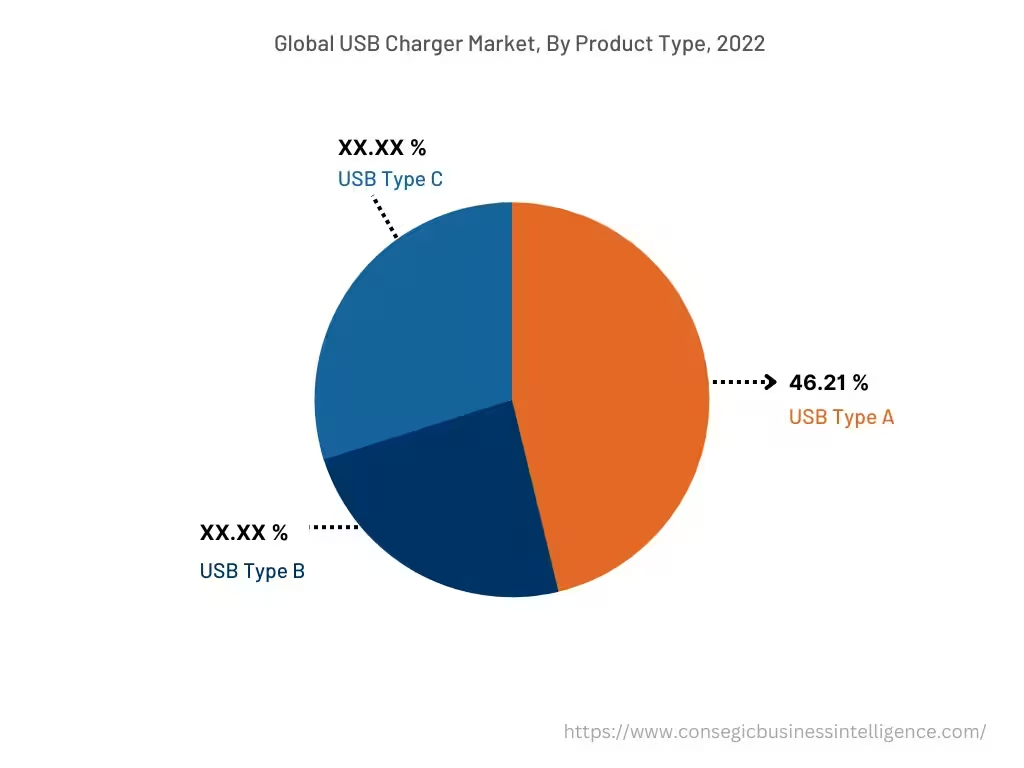
Based on product type, the market is split into USB Type A, USB Type B, and USB Type C. USB Type A held the largest revenue share historically thanks to its low cost, broad legacy compatibility, and simple one-way connector design, and it still powers a large installed base of older peripherals such as wireless mice, keyboards, and budget speakers.
USB Type C, however, is now the standard that both regulation and consumer preference favor, and it is expected to keep posting the fastest growth through 2033. Its symmetrical, reversible connector, support for data transfer, video output, and power delivery up to 240W make it the natural charging interface for smartphones, tablets, laptops, and gaming consoles alike. With Apple, Samsung, and Google all standardizing on USB-C, and with the EU's common-charger rule now covering both portable devices and, since April 2026, laptops, USB Type C has effectively become the default port for new consumer electronics rather than a premium option.
By Charger Type :
Based on charger type, the market is classified into Wall Charger, Portable Charger, and Car Charger. Wall chargers continue to hold the largest share, since they remain the essential accessory for virtually every USB-powered device, from smartphones to smartwatches. Rising ownership of USB-powered gadgets, along with the fast adoption of USB Type-C fast charging, keeps wall chargers as the anchor category of the market.
Portable chargers (power banks) are set to grow fastest through the forecast period as mobility, travel, and remote/hybrid work push demand for charging that isn't tied to a wall outlet. High-capacity portable chargers capable of powering laptops, not just phones, are widening this segment's addressable use cases and drawing in professionals, students, and frequent travelers alike.
By Port :
Segmented by port count into One, Two, Three, Four, and Others, single-port chargers remain the largest segment thanks to their low price, compact footprint, and suitability for casual single-device charging. However, four-port and multi-port chargers are the fastest-growing category, driven by households, offices, and travelers who need to power several devices — phones, tablets, headphones, power banks — from one outlet. Smart multi-port designs that automatically detect each connected device's power requirement and allocate wattage accordingly are a key reason this segment is scaling quickly.
By Power :
Segmented by output into 30W-45W, 45W-60W, 60W-75W, and Above 75W, the 45W-60W band remains the largest revenue contributor because it comfortably fast-charges smartphones, tablets, and gaming consoles without the added cost of laptop-class power electronics.
The Above-75W segment is forecast to grow the fastest, propelled by gaming laptops, professional workstations, and — following the EU's April 2026 laptop mandate — a wave of new USB-C laptops that require anywhere from 65W to 240W of Power Delivery. GaN-based high-wattage chargers are making this power band far more compact than earlier silicon-based designs, removing what used to be the main objection to carrying a high-power adapter day to day.
By Application :
Segmented by application into Smartphone, Tablet, Laptop, Desktop, and Others, smartphones remain both the largest revenue contributor and the fastest-growing application, since phones are recharged more frequently than any other device category and continue to add power-hungry features that demand faster charging. Laptops are the application to watch through 2033: the EU's phased rollout of mandatory USB-C charging for laptops is expected to accelerate replacement of proprietary laptop power bricks with standardized, higher-wattage USB-C chargers.
By Sales Channel :
Split between Online and Offline, offline channels — supermarkets, hypermarkets, convenience stores, and department stores — still capture the larger revenue share because they let shoppers compare brands and quality side by side before buying, and they offer manufacturers immediate sales and local visibility.
Online retail is the faster-growing channel, powered by rising internet penetration, the influence of social media and short-form product reviews, and the sheer convenience of e-commerce marketplaces such as Amazon, Flipkart, and Alibaba, which serve both individual and bulk commercial buyers.
By Region :
The regional split covers North America, Europe, Asia-Pacific, the Middle East & Africa, and Latin America.
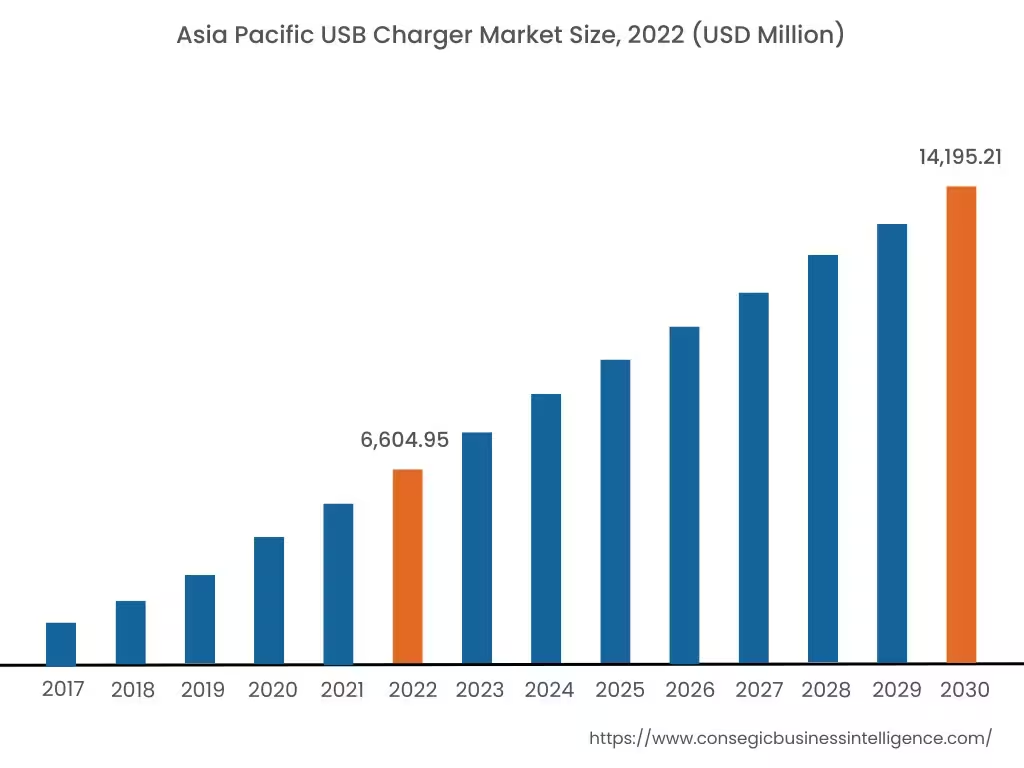
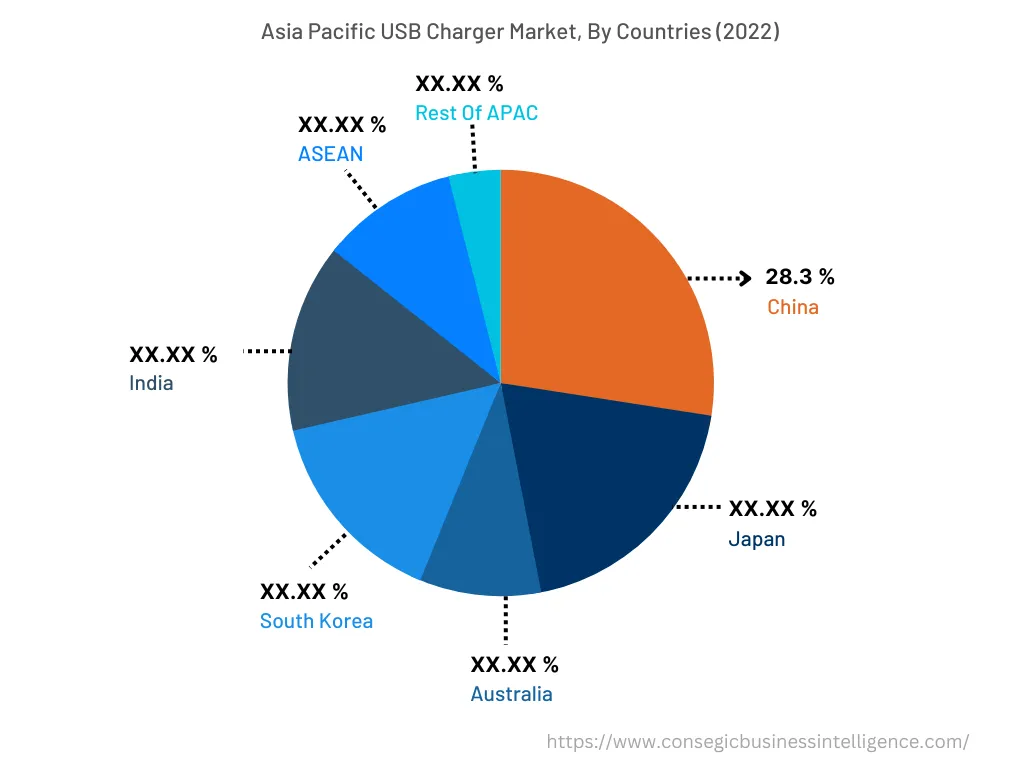
Asia-Pacific holds the largest and fastest-growing regional share, underpinned by a huge population base, rapidly rising smartphone and gadget penetration, and expanding middle-class purchasing power. China, India, South Korea, and Japan double as both manufacturing hubs and major consumption centers, and India's Bureau of Indian Standards mandate requiring USB Type-C ports on smartphones is adding further regulatory tailwind to regional demand.
Europe remains one of the largest markets by value and is entering a distinct new growth phase because of regulation rather than organic device growth alone. The EU's Common Charger Directive (EU) 2022/2380 has required USB-C charging on phones, tablets, cameras, and other small electronics since 28 December 2024, and extended that requirement to laptops from 28 April 2026 across the EU, Norway, Iceland, Liechtenstein, and the UK — a change expected to reshape purchasing patterns toward standardized, higher-wattage USB-C chargers throughout the region.
North America is characterized by a technologically advanced, early-adopting consumer base and high device-per-person ownership, and it continues to post steady growth on the back of fast-charging demand and expanding gaming and remote-work accessory purchases.
Top Key Players & Market Share Insights:
The USB charger market is highly fragmented and competitive, with global brands and regional manufacturers alike investing in R&D, GaN-based miniaturization, and multi-port intelligent charging technology to differentiate their product lines. Leading companies operating in the market include-
- Just Wireless
- Huntkey
- NCC Corp
- SDI Technologies
- AT&T Inc
- DB Power Limited
- Anker Innovations
- Petra Industries, LLC
- Baccus Global LLC
- Xiaomi
- Verizon
- Eaton
- Inter IKEA Systems BV
- Belkin
Recent Industry Developments :
- In April 2026, the EU's Common Charger Directive (EU) 2022/2380 came into force for laptops, requiring all new laptops sold in the EU, Norway, Iceland, Liechtenstein, and the UK to support USB-C charging with USB Power Delivery above 15W.
- In January 2025, a 32-port, 2000W USB-C desktop charger using smart identification and dynamic power regulation was introduced, illustrating how far multi-port fast-charging hardware has scaled for commercial and shared-use settings.
- In 2024-2025, several leading accessory brands expanded GaN-based 100W-140W multi-port charger lineups to address rising laptop and multi-device charging demand ahead of EU compliance deadlines.
- India's Bureau of Indian Standards continued rolling out its USB Type-C mandate for smartphones sold in the country, reinforcing the region's shift toward standardized charging hardware.
Key Questions Answered in the Report
How big is the USB charger market expected to be by 2033? −
The global USB charger market is projected to reach approximately USD 54.13 Billion by 2033, up from an estimated USD 32.22 Billion in 2025, growing at a CAGR of around 6.7% between 2026 and 2033.
What is driving USB charger market growth right now? +
Growth is being driven by rising ownership of smartphones, tablets, and laptops; growing demand for multi-port and high-wattage fast chargers; and government charging-port standardization rules, most notably the EU's Common Charger Directive, which now covers laptops as of April 2026.
Which product type leads the market — USB Type A, B, or C? +
USB Type A has historically held the largest revenue share due to its low cost and broad legacy compatibility, but USB Type C is the fastest-growing segment and is quickly becoming the default standard across smartphones, tablets, and laptops.
Which region dominates the USB charger market? +
Asia-Pacific leads the global market, supported by its large population, high device penetration, and major manufacturing base in China, India, South Korea, and Japan. Europe is a key growth region following its USB-C standardization mandate.
Overview
Reputation & Certifications


Our Services
- Market Intelligence & Forecasting
- Custom Research Solutions
- Market Entry Strategy
- Competitive Intelligence
- Customer Insights
- Industry Innovation Analysis
- Investment Advisory