Jump to Content
Anti Counterfeit Market - Size, Share, Industry Trends, and Forecasts (2025-2032)
Anti Counterfeit Market Size:
Anti Counterfeit Market size is estimated to reach over USD 408.83 Billion by 2032 from a value of USD 173.79 Billion in 2024 and is projected to grow by USD 190.38 Billion in 2025, growing at a CAGR of 12.6% from 2025 to 2032.
Anti Counterfeit Market Scope & Overview:
Anti counterfeit technology refers to a wide range of techniques and methods that are used for preventing counterfeiting and protecting products from being replicated or imitated. Anti-counterfeit technologies are designed to make it difficult for counterfeiters to replicate a product while facilitating consumers and businesses to identify and distinguish genuine products from fake ones. Moreover, anti counterfeit technology offers a range of benefits such as improved brand protection, reduced fraud, enhanced consumer safety, and others. The aforementioned benefits of anti counterfeit technology are key determinants for increasing its utilization in pharmaceutical, food & beverage, cosmetics & personal care, and other sectors.
How is AI Transforming the Anti Counterfeit Market?
There is an emerging use of AI in anti-counterfeit market. AI-powered solutions are being used to detect, prevent, and combat the spread of counterfeit goods across various industries. Moreover, AI-powered systems can analyze product images, identify patterns, and compare them against a validated database to detect counterfeits with high accuracy.
Further, AI-powered solutions also help in monitoring online marketplaces, identifying counterfeit listings, and even tracing the source of fake goods. Thus, the above factors are anticipated to boost the market growth in upcoming years.

Anti Counterfeit Market Dynamics - (DRO) :
Key Drivers:
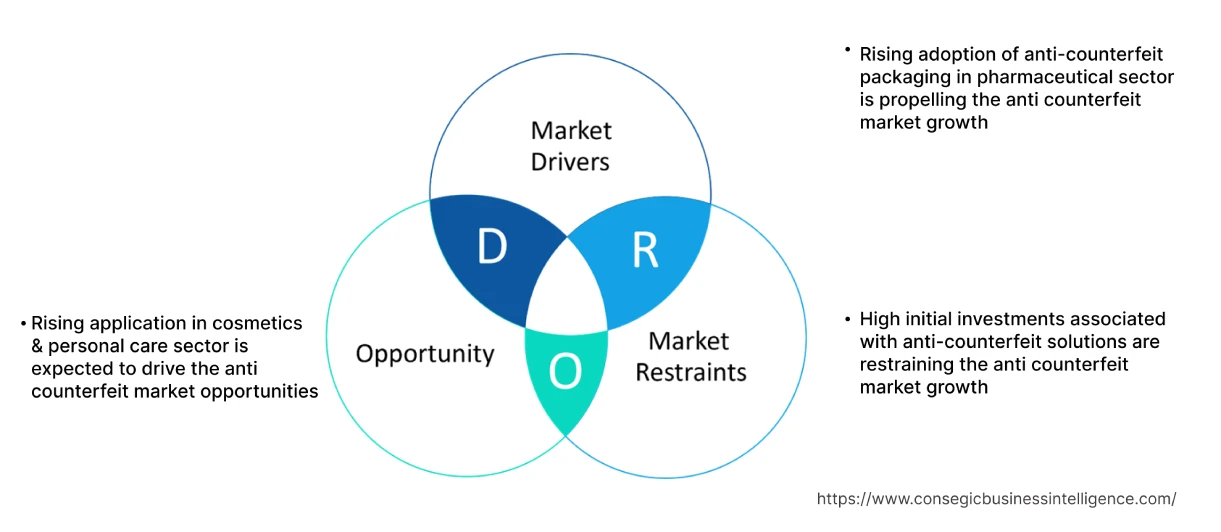
Rising adoption of anti-counterfeit packaging in pharmaceutical sector is propelling the anti counterfeit market growth
Counterfeit drugs and pharmaceutical products can cause significant risks, particularly concerning public health, patient safety, loss of revenue for manufacturers, and damage to brand reputation. Anti-counterfeit packaging is primarily used in pharmaceutical sector for preventing the replication or forgery of pharmaceutical products. The use of anti-counterfeit measures helps ensure that consumers receive genuine pharmaceutical products while maintaining regulatory compliance.
- For instance, according to the European Federation of Pharmaceutical Industries and Associations (EFPIA), the total production of pharmaceutical industry in Europe was valued at USD 430.42 billion in 2023, witnessing a growth of nearly 7.3% in comparison to USD 400.95 billion in 2022.
Hence, the rising pharmaceutical production is driving the adoption of anti-counterfeit packaging for preventing the replication or forgery of pharmaceutical products, thereby, proliferating the anti counterfeit market size.
Key Restraints:
High initial investments associated with anti-counterfeit solutions are restraining the anti counterfeit market growth
The initial investment associated with anti-counterfeit solutions is usually high, owing to adequate capital investment required for research & development, machinery, technologies, and labor. This may cause financial barriers, specifically for smaller businesses or businesses operating on tighter budgets, in turn limiting its adoption.
The high initial setup and innovation costs required for development of anti-counterfeit solution discourages both new companies and potential consumers from completely accepting anti-counterfeit solution. Hence, the aforementioned factors are hindering the anti counterfeit market expansion.
Future Opportunities :
Rising application in cosmetics & personal care sector is expected to drive the anti counterfeit market opportunities
There is a rising adoption of anti counterfeit packaging in the cosmetics and personal care sector for protecting consumers, brands, and product integrity. Anti-counterfeit packaging is typically used in cosmetics & personal care products such as moisturizing creams and lotion bottles, shampoos, perfumes, and others in order to maintain the brand’s authenticity while protecting the consumers from using duplicate or fake products.
- For instance, according to Cosmetics Europe (Personal Care Association), the largest markets for cosmetics and personal care products within Europe include Germany with retail sales value of USD 17.5 billion in 2023, followed by France with USD 15.1 billion, Italy with USD 13.8 billion, UK with USD 12.1 billion, Spain with USD 11.5 billion, and Poland with USD 5.7 billion among others.
Thus, as per the analysis, the growing cosmetics & personal care sector is projected to increase the adoption of anti-counterfeit solutions, in turn driving the anti counterfeit market opportunities during the forecast period.
Anti Counterfeit Market Segmental Analysis :
By Technology Type:
Based on technology type, the market is segmented into barcodes & QR codes, hologram, radio frequency identification (RFID), forensic markers, tamper evidence, mass serialization, watermarks, and others.
Trends in the technology type:
- Increasing trend in adoption of barcodes & QR codes for anti-counterfeiting due to its quick verification, improved inventory management, and cost-efficiency is driving the anti counterfeit market size.
- There is a rising trend towards utilization of RFID technology in anti-counterfeiting, attributing to its several benefits such as unique identification, enhanced tracking and traceability, increased speed and efficiency in authentication, and others.
The barcodes & QR codes segment accounted for a significant revenue share in the total anti counterfeit market share in 2024.
- Barcodes refer to graphical representations of data, which is typically arranged in parallel lines of varying widths. Barcodes are used for encoding information such as product ID, manufacturer data, or price, which can be scanned using a barcode reader.
- Meanwhile, QR codes are used for storing more information than standard barcodes, which can be scanned using a smartphone camera, further directing the user to websites or displaying information about the product.
- Moreover, scanning barcodes enables quick verification of product authenticity and inventory checks while reducing the time required for manual audits.
- Additionally, barcodes & QR codes offers several benefits such as ease of utilization, improved inventory management, quick verification, and cost-efficiency among others.
- For instance, NanoMatriX Technologies Limited offers TrackMatriX Lock in its solution offerings, which is a secure anti-counterfeit QR code that consist of covert and overt information. The company’s secure tracking QR code technology is designed for offering protection against counterfeiting and forgery.
- According to the anti counterfeit market analysis, the rising advancements associated with barcode & QR code anti-counterfeit solutions are driving the anti counterfeit market trends.
Radio frequency identification (RFID) segment is anticipated to register a substantial CAGR growth during the forecast period.
- RFID technology uses electromagnetic fields for automatically identifying and tracking tags that are attached to objects. Each RFID tag contains a unique identifier that can be read by RFID readers.
- Moreover, RFID technology offers unique identifiers for each product, which makes it nearly impossible for counterfeiters to replicate. Each tag consist of particular information that differentiates genuine products from fake products, in turn assisting in easy verification.
- Additionally, the utilization of RFID technology in anti-counterfeiting enables quicker and efficient verification of products while significantly decreasing the time and resources required for manual verification.
- Further, RFID based anti-counterfeit technology offers a range of benefits such as distinctive identification, enhanced tracking and traceability, increased speed and efficiency in authentication, and others.
- Thus, the above benefits of RFID technology are projected to drive its adoption for anti-counterfeit solutions, in turn boosting the market during the forecast period.
By End-User:
Based on the end-user, the market is segmented into pharmaceuticals, food & beverage, cosmetics & personal care, electrical & electronics, automotive, apparel & footwear, and others.
Trends in the end-user:
- Factors including rising development of pharmaceutical manufacturing facilities, increasing pharmaceutical production, and growing anti-counterfeit packaging for pharmaceutical products are key trends driving the growth of the pharmaceutical segment.
- Increasing trend in adoption of anti-counterfeit packaging in cosmetics & personal care sector for protecting consumers, brands, and product integrity.
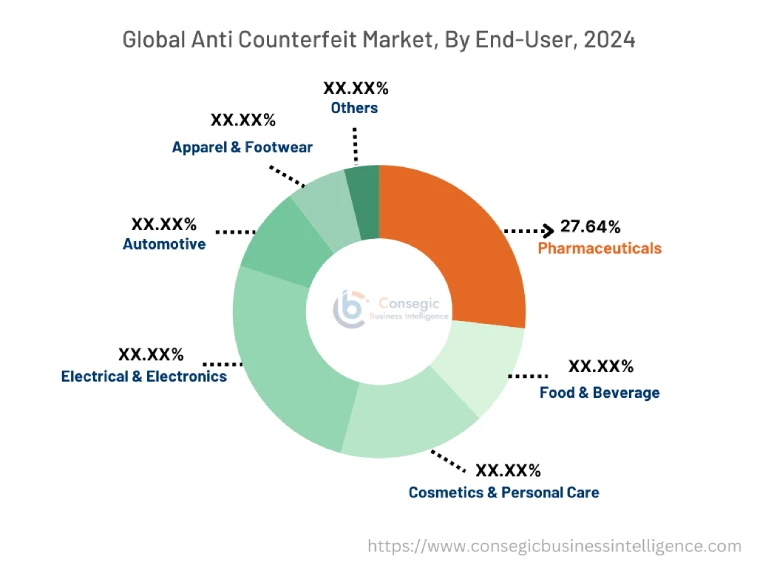
The pharmaceuticals segment accounted for the largest revenue share of 27.64% in the overall anti counterfeit market share in 2024.
- Anti counterfeit solution is primarily used in pharmaceutical sector for preventing the replication or forgery of pharmaceutical products for preventing patient safety, loss of revenue for pharmaceutical manufacturers, and damage to brand reputation.
- Moreover, the utilization of anti-counterfeit solution in pharmaceutical sector helps ensure that consumers receive genuine pharmaceutical products while maintaining regulatory compliance.
- For instance, according to the India Brand Equity Foundation, the local pharmaceutical sector in India consist of approximately 3,000 drug companies and 10,500 pharmaceutical manufacturing unit.
- According to the analysis, the rising pharmaceutical manufacturing is driving the adoption of anti-counterfeit packaging for preventing the replication or forgery of pharmaceutical products, in turn propelling the market.
Cosmetics & personal care segment is anticipated to register a substantial CAGR growth during the forecast period.
- Anti-counterfeit packaging is often used in such as moisturizing creams and lotion bottles, shampoos, perfumes, and others in order to maintain the brand’s authenticity while protecting the consumers from using duplicate or fake products.
- Moreover, the use of anti-counterfeit packaging in cosmetics and personal care products helps in protecting consumers, brands, and product integrity.
- For instance, according to Japan Cosmetic Industry Association (JCIA), cosmetic shipments in Japan reached approximately USD 9.23 billion in 2023, witnessing an increase of 2.9% increase as compared to 2022.
- Thus, the growing cosmetics & personal care sector is projected to drive the market growth during the forecast period.
Regional Analysis:
The regions covered are North America, Europe, Asia Pacific, the Middle East and Africa, and Latin America.
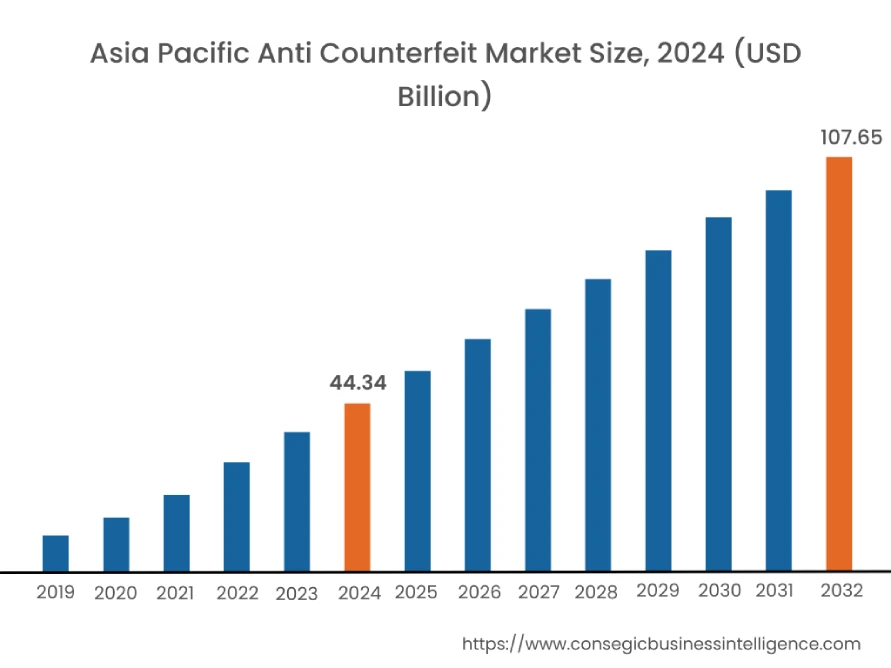
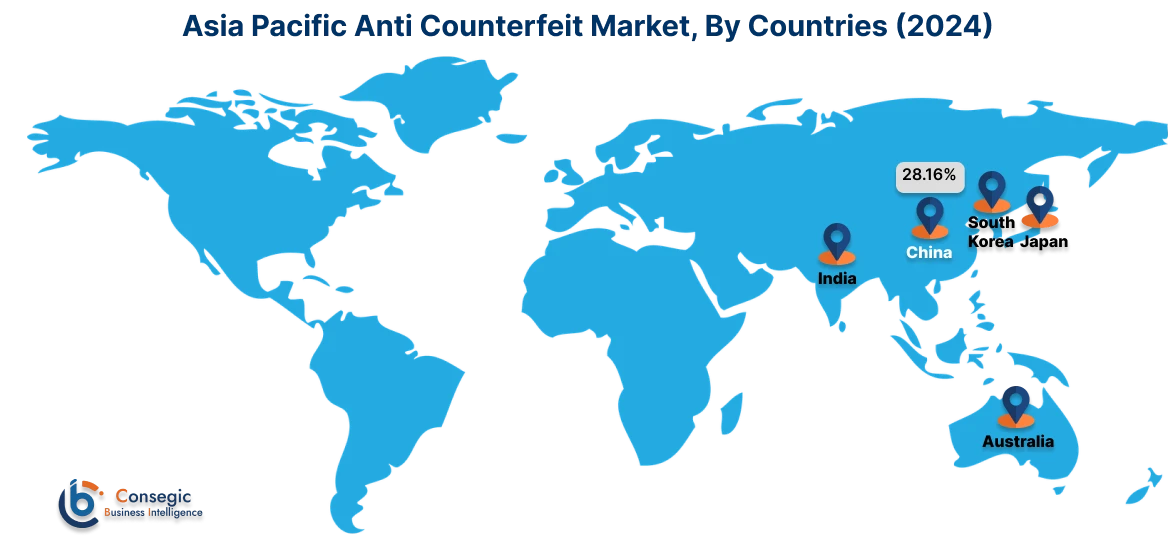
Asia Pacific region was valued at USD 44.34 Billion in 2024. Moreover, it is projected to grow by USD 48.70 Billion in 2025 and reach over USD 107.65 Billion by 2032. Out of this, China accounted for the maximum revenue share of 28.16%. As per the anti counterfeit market analysis, the adoption of anti-counterfeit technologies in the Asia-Pacific region is primarily driven by growing pharmaceutical, cosmetics & personal care, apparel, and other sectors. Additionally, the rising pharmaceutical production and favorable government measures for adopting anti-counterfeit solutions for pharmaceutical products are further accelerating the anti counterfeit market expansion.
- For instance, the Indian Government stated that over 300 brands of medicines that are manufactured or retailed in India will be required to bear a web-linked dynamic barcode or QR code, mainly on their primary packaging from August 2023. This move aims at dealing with the prevalent issue of counterfeiting in the country’s pharmaceutical sector. The above factors are further driving the adoption of anti-counterfeit technology, in turn propelling the anti counterfeit market trends in the Asia-Pacific region.
North America is estimated to reach over USD 141.21 Billion by 2032 from a value of USD 60.01 Billion in 2024 and is projected to grow by USD 65.74 Billion in 2025. In North America, the growth of anti counterfeit industry is driven by rising investments in food & beverage, electronics, apparel & footwear, and pharmaceutical production among others. Moreover, the increasing prevalence of counterfeit products is further contributing to the anti counterfeit market demand.
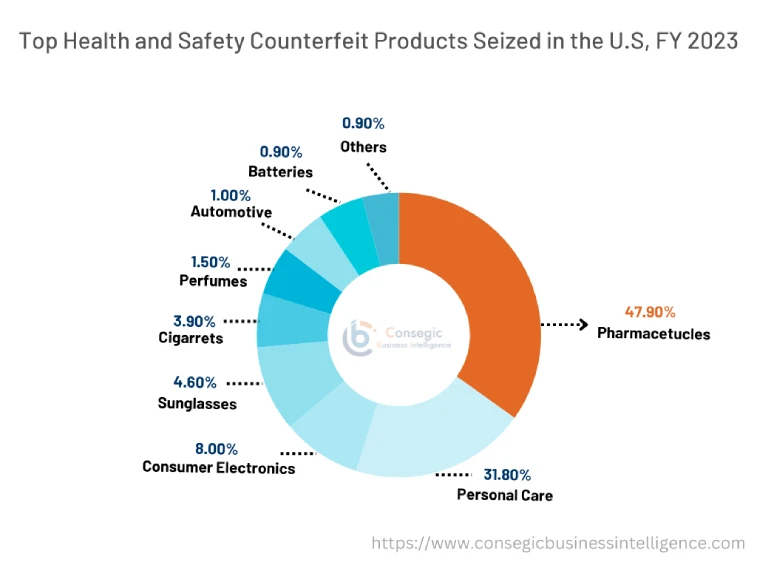
- For instance, according to the S Customs and Border Protection, the counterfeit pharmaceuticals accounted for approximately 47.9% of the total number of health and safety products seized in the U.S in FY 2023, followed by personal care products with 31.8%, consumer electronics with 8%, and others. The above factors are projected to drive the market demand in North America during the forecast period.
In addition, the regional analysis depicts that the rising investments in cosmetics & personal care sector along with increasing pharmaceutical and automotive production are driving the anti counterfeit market demand in Europe. Furthermore, as per the market analysis, the market demand in Latin America, Middle East, and African regions is expected to grow at a considerable rate due to factors such as rising electronics production, increasing apparel & textile production, and growing demand for anti-counterfeit solutions to protection brand and consumer product integrity among others.
Top Key Players and Market Share Insights:
The global anti counterfeit market is highly competitive with major players providing solutions to the national and international markets. Key players are adopting several strategies in research and development (R&D), product innovation, and end-user launches to hold a strong position in the anti counterfeit market. Key players in the anti counterfeit industry include-
- Avery Dennison Corporation (U.S)
- CCL Industries Inc. (Canada)
- SICPA Holding SA (Switzerland)
- Authentix Inc. (U.S)
- 3M Company (U.S)
- Dai Nippon Printing Co. Ltd. (Japan)
- Tesa SE (Germany)
- HID Global Corporation (U.S)
- Abbey Labels (United Kingdom)
- Alien Technology Corp. (U.S)
Recent Industry Developments :
Product Launch:
- In November 2024, Digimarc Corporation launched its new advanced anti-counterfeit solution for empowering security solutions providers and businesses with the tools required to protect government programs, businesses, and citizens worldwide. The anti-counterfeit solution combines secure digital watermarks with new mobile authentication technology, which delivers an exceptional ability for safeguarding physical assets against counterfeit threats.
Anti Counterfeit Market Report Insights :
| Report Attributes | Report Details |
| Study Timeline | 2019-2032 |
| Market Size in 2032 | USD 408.83 Billion |
| CAGR (2025-2032) | 12.6% |
| By Technology Type |
|
| By End-User |
|
| By Region |
|
| Key Players |
|
| North America | U.S. Canada Mexico |
| Europe | U.K. Germany France Spain Italy Russia Benelux Rest of Europe |
| APAC | China South Korea Japan India Australia ASEAN Rest of Asia-Pacific |
| Middle East and Africa | GCC Turkey South Africa Rest of MEA |
| LATAM | Brazil Argentina Chile Rest of LATAM |
| Report Coverage |
|
Key Questions Answered in the Report
How big is the anti counterfeit market? −
The anti counterfeit market was valued at USD 173.79 Billion in 2024 and is projected to grow to USD 408.83 Billion by 2032.
Which is the fastest-growing region in the anti counterfeit market? +
Asia-Pacific is the region experiencing the most rapid growth in the anti counterfeit market.
What specific segmentation details are covered in the anti counterfeit report? +
The anti counterfeit report includes specific segmentation details for technology type, end-user, and region.
Who are the major players in the anti counterfeit market? +
The key participants in the anti counterfeit market are Avery Dennison Corporation (U.S), CCL Industries Inc. (Canada), SICPA Holding SA (Switzerland), Authentix Inc. (U.S), 3M Company (U.S), Dai Nippon Printing Co. Ltd. (Japan), Tesa SE (Germany), HID Global Corporation (U.S), Abbey Labels (United Kingdom), Alien Technology Corp. (U.S), and others.
Overview
Reputation & Certifications


Our Services
- Market Intelligence & Forecasting
- Custom Research Solutions
- Market Entry Strategy
- Competitive Intelligence
- Customer Insights
- Industry Innovation Analysis
- Investment Advisory